
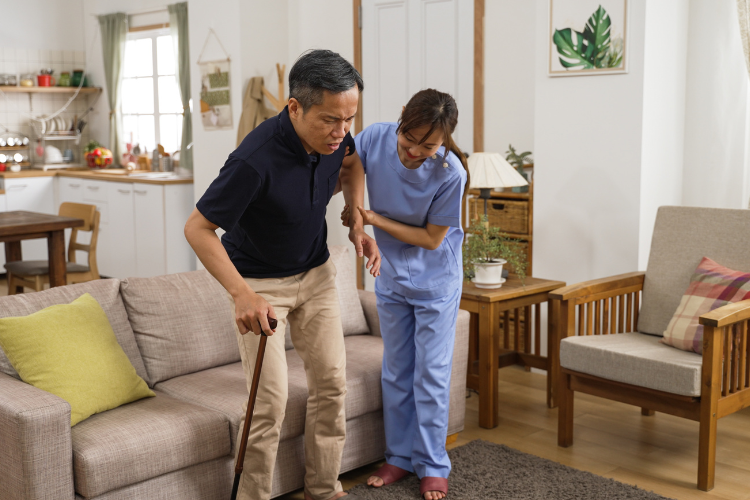
The fall itself is usually not the story. The six months after it are.
A woman in her eighties trips on the edge of a rug, catches herself on the counter, and does not break anything. Everyone exhales. But she stops walking to the mailbox. She skips the Sunday lunch because getting in and out of the car feels risky now. She starts holding onto furniture as she moves around the house, which is its own warning sign. By spring she is weaker than she was in the fall, and the next time she goes down it is worse. This is often when families begin considering in-home care for seniors.
That is the pattern I see most often, and the fall that starts it is almost never dramatic. It happens in a familiar room, doing something ordinary, in the middle of the day.
What Actually Causes Falls
Families tend to blame clumsiness or bad luck. It is usually something more specific, and most of it can be dealt with.
Medications are near the top of the list. Blood pressure medication that makes someone lightheaded when they stand up. Sleep aids that are still working at 3 AM when she gets up for the bathroom. Anything new, anything changed, anything that adds up when there are eight bottles on the counter. A medication review with the doctor or pharmacist is one of the highest value hours a family can spend, and it costs nothing.
Then there is strength and balance, which fade quietly. Sitting more, walking less, and eating less protein than she used to. It shows up as a slower walk and a harder time getting out of a low chair.
Vision and lighting matter more than people think. Bifocals and stairs are a bad combination. So is a dark hallway at 2 AM. Most nighttime falls happen on the path between the bed and the bathroom.
Feet and shoes are worth a look too. Slippers with no back, socks on hardwood, a foot problem nobody mentioned because it seemed too small to bring up.
And there is often something medical underneath. Dehydration, a urinary infection, a change in the heart rhythm, early cognitive change. A first fall is worth a real conversation with the doctor, not just an ice pack.
The Changes That Make the Biggest Difference
Home safety advice usually arrives as a long checklist that nobody finishes. If you only do a few things, do these.
- Fix the path from the bed to the bathroom. Clear it, light it with something motion activated, and make sure nothing on that route requires a hand on the wall.
- Put grab bars where the hands actually go, which is getting in and out of the shower and getting up from the toilet. A towel bar is not a grab bar and will come out of the wall.
- Take up the throw rugs. All of them. This is the argument you will have and it is worth having.
- Get a chair she can stand up from without a push, and a bed at a height where her feet reach the floor.
- Deal with the shoes. Something with a back and a sole that grips, worn in the house, not just outdoors.
- And have a way to call for help that is on her body, not on the kitchen counter. The danger with living alone is rarely the fall itself. It is lying on the floor for six hours because the phone was in the other room.
When Help at Home Is the Honest Answer
There is a point where the house has been fixed as much as a house can be fixed, and the risk is still there, because the risk is not really about the house.
A few signs that you are at that point. She has fallen more than once in a year. She is afraid to be alone and will not say so. She cannot get up off the floor on her own, which you can find out by asking. She is not eating properly because cooking has become too much. The bathroom at night is genuinely unsafe. Or you are lying awake wondering whether the phone is going to ring.
Help at home does not have to mean somebody there around the clock. For a lot of families it starts with a few mornings a week, someone to be there for the shower, which is where a lot of bad falls happen, plus the meals, the errands, and a set of eyes on how she is actually doing. Sometimes it means someone overnight for a while. It changes as things change.
And sometimes, after a second or third fall, the honest answer is that living alone is no longer working, and a small home with people around is the safer life. That is not a failure. It is usually the thing that gets someone another few good years.
Start With One Thing
If somebody in your family had a fall recently, even a small one, do not let it pass as nothing. Get the medications reviewed, walk the route from the bed to the bathroom yourself at night, and ask her plainly whether she has become afraid of falling. The answer to that one tells you a great deal.
If you want a second set of eyes on the house and on how she is really managing, that is what a care assessment is for. You can read about our in-home care and our geriatric care management, or contact our team and we will come take a look.